
Learning Theory by Kara

Cognitive Development Learning Theory
What it's all about...
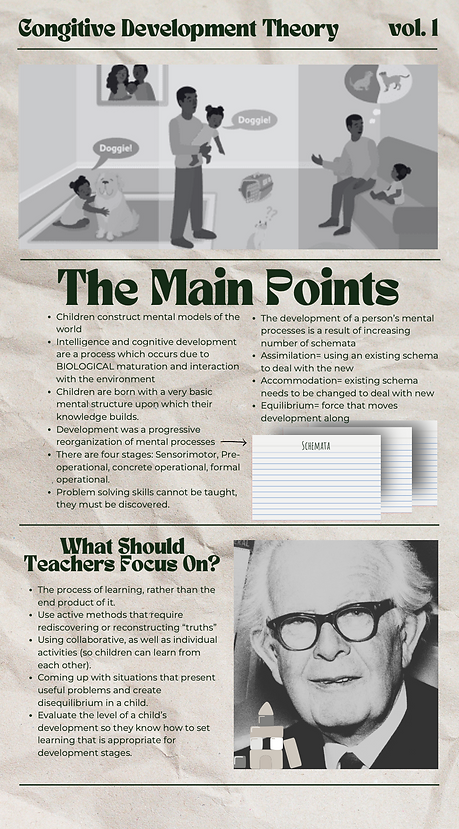
Cognitive development learning theory is all about trying to discover how humans go about making sense of the world with their ability to gather and organize information. Cognitive development learning theory suggests that our thinking processes change as we age, mature, interact with our environment, socialize with others, and reorganize information.
Key Terms Associated with Cognitive Development
Equilibration
Accommodation
A force that moves development along. It usually occurs in leaps and bounds and attempts to refine what we know to achieve mental balance.
Schemes
Bits of knoweldge that allow us to form mental representations of the world.
Assimilation
Uisng an existing schema to deal with something new.
Sensorimotor Stage
Birth to age two where children are discovering the difference between oneself and the environment. This involves the senses and motor activity.
An existing schema needs to be changed or a new one needs to be created to deal with something new.
Pre-operational stage
Age two to age seven when children typically think about things symbolically. Children usually only think in the present and have difficulty understanding the point of view of another person.
Concrete Stage
Age seven to eleven when children use logic in concrete (solid) ways. Children now understand the past, present, and future.
Formal Operational Stage
Age eleven through adulthood when children begin to understand theories and abstract processes. They can think hypothetically, deductively, and in a logical fashion.

Pre-Operational Stage
In Action
In the pre-operational stage children take things literally. They do not yet understand the complex, figurative, or exaggerated meanings of speech. In this clip Chucky is perplex, worried, and terrified because he ate a watermelon seed and thinks a watermelon will actually grow in his stomach. He takes what the adult says literally.
This activity helped me understand the depth of Cognitive Development theory and how it can help teachers connect students with curriculum, lessons, and material. For example, if you discover that students already know how to add and subtract (a existing schema) then you may easily introduce a lesson on spending and saving money.


What I Learned...
I learn that students all learn at different stages. Each student will acquire information in their own unique way. As a teacher I must understand where my students are in their development journey and cater my lessons in a manner that will give them the best opportunity to learn from their own experiences and knowledge.